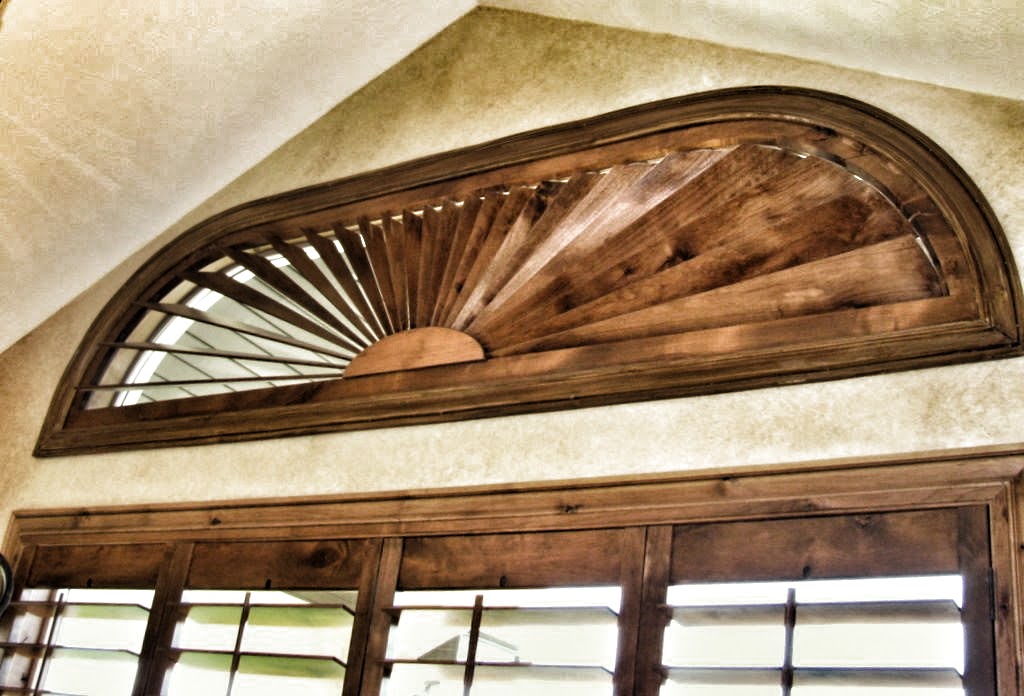
One of our most frequently asked questions is why Stanfield Shutter uses flat louvers instead of oval louvers. We feel:
1-The
slim-line horizontal design louver looks more like a shutter.
2-The
slim-line horizontal design louvers offer a better view.
3-The
louver to tilt rod connection is more secure.
4-There
are fewer nicks in the slim-line horizontal design louver blade.
5-Symetry—oval
louvers are frequently lopsided.
6-The
overall finish is smoother and nicer.
1. Almost
20 years ago Grant (one of our sales consultants) and Gary (the general
manager) were approached by several designers with a problem. Their customers were
complaining because their guest kept complimenting them on their blinds when they
had paid good money for shutters. After researching the
problem it was determined that the small edge of the oval louver made the
shutter look more like a blind then a shutter. Once the slim-line horizontal
design louver was introduced the problem was resolved and our customers were
much happier.

2. The
slim-line horizontal design louvers actually offer a better view then the
archaic oval louvers. The diagrams you see are actual representations of our slim-line
flat louvers compared to the oval louvers of our competition. The difference is astounding! As these scale
representations show the slim-line horizontal design louver is almost eighth of an inch
thinner then its oval counterpart. On standard windows you could have 2 ¼ to 5 ½ inches
more viewing space just by choosing the slim-line horizontal design louver!

3. Because
the slim-line horizontal design louver has more meat on the edges the staples
used to connect the tilt rod to the louvers hold tighter and longer then those
in the oval louvers. Because of the increased meat the louvers do not break out
around the staple like the oval louvers do. In addition, the oval louver only
has a small edge for a
staple to hit to be perfectly aligned. Many staples on oval louvers miss their
mark and look funny because they are on the surface of the louver instead of on
the edge where they are supposed to be.

4.
Whenever you ask a professional mill worker to mill wood for you he will ask
how many knife marks per inch are acceptable. What he wants to know is how many
knife nicks you will accept per every inch of the wood. Since oval louvers must
be manufactured with larger and wider blades the opportunity for the blade to
nick the wood increases dramatically which will eventually show up in the final
product as little lines in the paint or dark lines in stained shutters.
5. If you
have ever looked at an oval louver from the side you would be able to see that
the louver is uneven. The edge of the front is smaller or bigger then the edge
on the back, the curve of the louver is different on the top and bottom and
from left to right, and so forth. On the other hand, the slim-line horizontal
design louver is
perfectly symmetrical on all sides giving it a nice, balanced look and feel.

6.
Shutters are very difficult to finish properly. There are many different angles
to spray and multiple parts that have to be adjusted to obtain a nice finish.
Because of this most shutters are primed and sanded before they are finished.
Electrical sanders, however, are flat which makes sanding oval louvers properly
difficult at best. Trying to sand the curve of the oval louver by hand is
sketchy at best since the human hand will never maintain a constant shape and
will not be able to apply constant pressure to the sand paper and the louver.
In short, the finish on oval louvered shutters is more inconsistent and not as
smooth as the slim-line horizontal design louvered shutters.

For over 20 years
Stanfield Shutter has been using the slim-line horizontal design louver in our
shutters. To date we have not had a
single recorded complaint concerning the design, in fact, we receive
compliments on a routine basis. If you are looking for a shutter that looks
like a shutter then a shutter built by Stanfield Shutter with the slim-line
horizontal design louver is the right shutter for you.